Measure the whole circle.
A 72-inch fan has a 36-inch radius. Measure from its center to every wall, post and moving door—not just the room’s overall width.
 FIXEDELECTRIC918.264.8594LET’S TALK
THE FIXED ELECTRIC FAN GUIDE
From a quiet bedroom to your favorite covered patio, a great fan starts with the space around it. Plan the size and hanging height, then let us help with the final fit.
PLAN MY FAN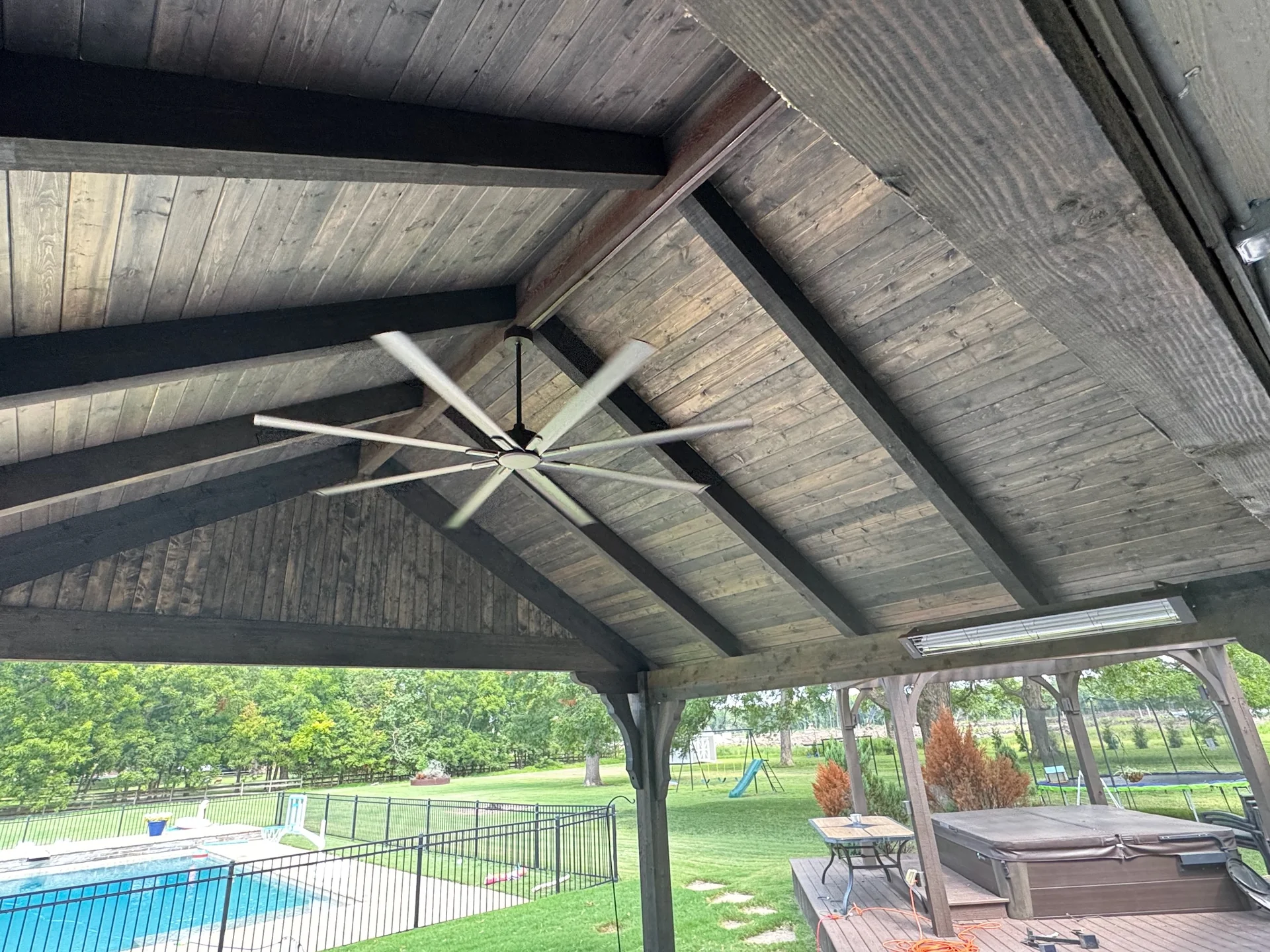
A 72-inch fan has a 36-inch radius. Measure from its center to every wall, post and moving door—not just the room’s overall width.
Beams and sloping ceilings can enter the blade path. A longer rod may create clearance above, while reducing the space below.
Use the lowest blade edge when checking floor clearance. Check the light kit, raised floors, stairs and tall furniture separately.
MEASURE FIRST. CHOOSE WITH CONFIDENCE.
This is a planning estimate for a single fan. Your fan’s instructions and our site measurements determine the final installation.
A FAN WE LIKE TO USE
A larger fan can make a statement in a generous room or suitable covered patio. Clearance, airflow and exposure still decide whether it belongs in yours.
Black and walnut blade finishes, eight blades, a light and remote-controlled six-speed DC motor. A Fixed Electric preferred option to discuss for your project.
Location matters: the linked listing describes indoor and covered outdoor use and says it is not waterproof. We must confirm the exact model’s damp/wet rating for your patio; do not select it for rain-exposed locations.
The listing shows 4-, 8- and 24-inch rods. Included rods do not guarantee fit. Verify the selected variant and current manual; its advertised overall height is not a blade-clearance measurement.
A FEW THINGS WORTH GETTING RIGHT
Sometimes. It lowers the entire fan, which may clear an overhead obstruction but leave too little height above the floor. If those limits overlap, consider a smaller fan, another mounting position or a different fan design. Beams, door swings and lights must be checked on site before choosing hardware.
A dry indoor room and an open patio have different needs. A sheltered, humid location calls for an appropriately damp-rated fan. Direct or wind-driven rain calls for a wet-rated model approved for that exposure. “Outdoor” in a product title alone does not establish its rating.
Compare the manufacturer’s airflow rating (CFM), coverage guidance and speed range, as well as blade span. Large or long patios may benefit from more than one fan over the occupied areas. Each fan needs its own clearance and mounting review.
Side clearance equals the measured center-to-obstacle distance minus half the blade span. For one uniform ceiling slope, the tool accounts for the ceiling dropping toward the upslope blade tip and checks the shortest gap to that plane. It also compares any entered overhead obstruction with the top of the blades, and checks the lowest blade edge against the floor limit.
The downrod estimate adjusts your reference blade heights by the change in rod length. It does not assume different brands’ rods are interchangeable, or that a product’s total height identifies its blade position. Complex roofs, multiple slopes, unmeasured objects, blade flex and unusual mounts need our review.
Room-size starting ranges: ENERGY STAR fan basics ↗. General mounting guidance: Hunter’s measurement guide ↗. Product details: the linked ZMISHIBO listing ↗. The specific fan’s instructions take priority over this general planner.
GOOD THINGS START WITH A CONVERSATION.